Intuned Wants to Be the Deployment Layer for Your Playwright Automations
The YC S22 startup just relaunched with an AI agent that generates, deploys, and self-heals Playwright code—so you keep the code ownership without the infrastructure headache.
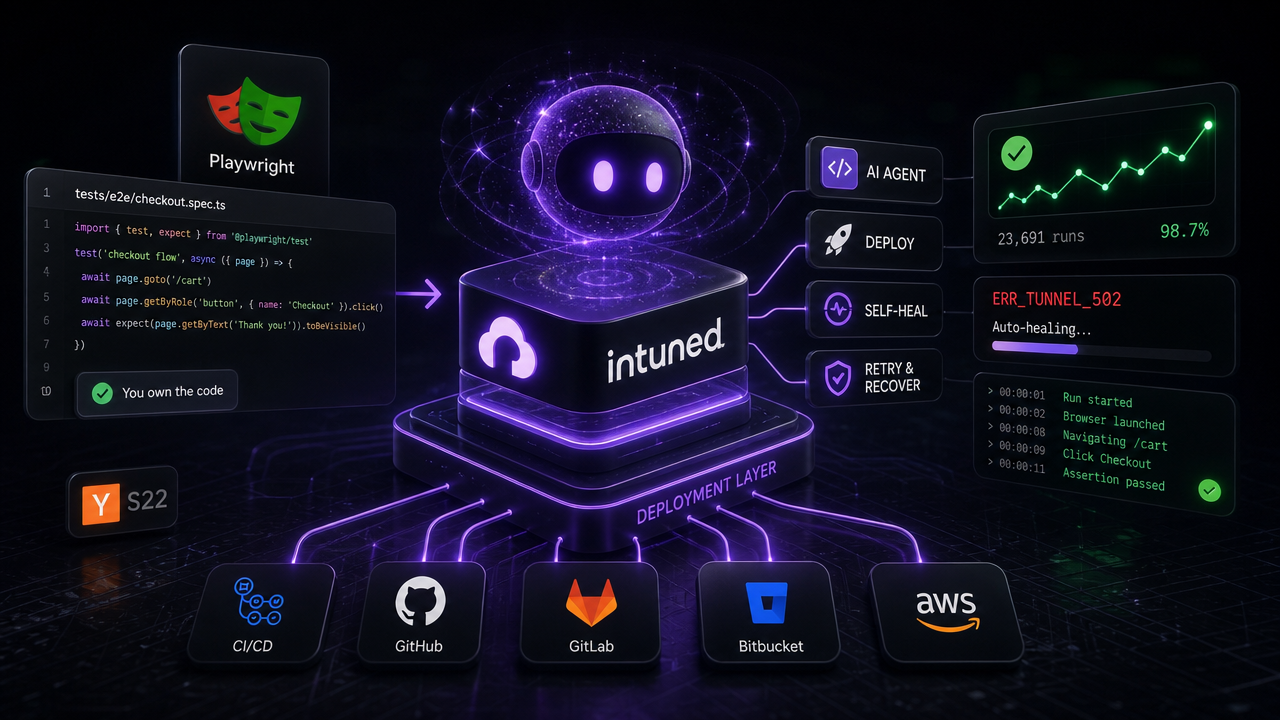
Browser automation has a reliability problem. Recorded scripts break the moment a site redesigns a button. Hand-rolled Playwright jobs work until they don't, and then someone has to debug a headless browser at 2 AM. Intuned (YC S22) is pitching a different model: treat automations as versioned, code-first artifacts on a managed platform that handles everything from stealth to scaling—and now uses an AI agent to generate and maintain that code for you.
Code You Own, Infrastructure You Don't
The core thesis is that the real cost of browser automation isn't writing it the first time—it's keeping it running. Sites change. CAPTCHAs evolve. Sessions expire. Intuned's platform wraps Playwright jobs in a runtime that handles the operational surface area developers don't want to deal with:
- Stealth & anti-detection — built-in proxy rotation and fingerprint evasion
- Auth lifecycle — you write
create.ts/check.ts(or their Python equivalents); Intuned manages validating, reusing, and recreating sessions automatically - Scheduled jobs with full logs and session recordings — recurring runs without babysitting cron
- Auto-scaling — one machine or hundreds, concurrency limits you set, queuing handled by the platform
- API-first RPA — deploy any automation as an API endpoint with configurable parallel execution limits
Critically, the code stays yours. Intuned explicitly calls out that there's no lock-in and no black-box reselling—you can take your Playwright scripts and run elsewhere.
Intuned Agent: Prompt-to-Playwright
The headline feature of the relaunch is Intuned Agent. Describe what you need, provide a target schema, and the agent generates production-ready Playwright code, deploys it to the platform, and—this is the differentiator—fixes it automatically when the target site changes.
For scraping use cases, the workflow becomes:
- Describe the site and the data shape you want
- Agent generates TypeScript or Python Playwright code
- Code runs on Intuned's infrastructure with stealth, scheduling, and monitoring built in
- When the site updates and the scraper breaks, the agent patches it
That last step is where most DIY setups fail silently. Intuned is betting that AI-assisted maintenance is more durable than any selector strategy.
Mixing Deterministic Code with AI-Driven Steps
For teams already evaluating AI browser agents, Intuned supports the full current ecosystem: Anthropic Computer Use, OpenAI CUA, Stagehand, Browser-use, and Gemini Computer Use can all be deployed on the same infrastructure. More interestingly, you can mix deterministic Playwright logic with AI-driven steps in a single automation—use hardcoded selectors where the page structure is stable, fall back to a vision model where it isn't.
The platform also adds AI usage controls so you can monitor and cap AI credit consumption across your automations, which matters when you're running hundreds of concurrent jobs.
For crawlers specifically, Intuned has added first-class support for Crawl4AI, letting teams deploy and scale their existing Crawl4AI workflows without managing the underlying infrastructure.
Managed Scraping as a Tier
For teams that need hundreds or thousands of scrapers and don't want to build them at all, Intuned offers a managed tier: describe the sites and schemas, and their solution engineers—augmented by Intuned Agent—deliver production-ready scrapers. They note they've delivered thousands of production scrapers this way. Pricing is a flat fee per source or custom arrangements, and you still own the code.
This positions Intuned somewhere between a self-serve infra platform (like Browserless or Apify) and a fully managed data-delivery service—with the AI agent as the force multiplier that makes the economics work at both ends.
The Practical Take
For developers already using Playwright, the pitch is essentially: stop managing browser infrastructure and stop writing maintenance patches. Write TypeScript or Python against the Playwright API you already know, push it to Intuned, and let the platform—and increasingly the agent—handle the operational burden.
The code-first, no-lock-in approach is the right call architecturally. The real question is whether Intuned Agent's self-healing is reliable enough at scale to justify the platform dependency. That's worth testing against your most fragile production scraper.
Discussion 0
Join the discussion
Sign in with GitHub to comment and vote.
No comments yet
Be the first to weigh in.